The Emotional Politics of Afro-Dominicans in Denial of Their Blackness - Part I
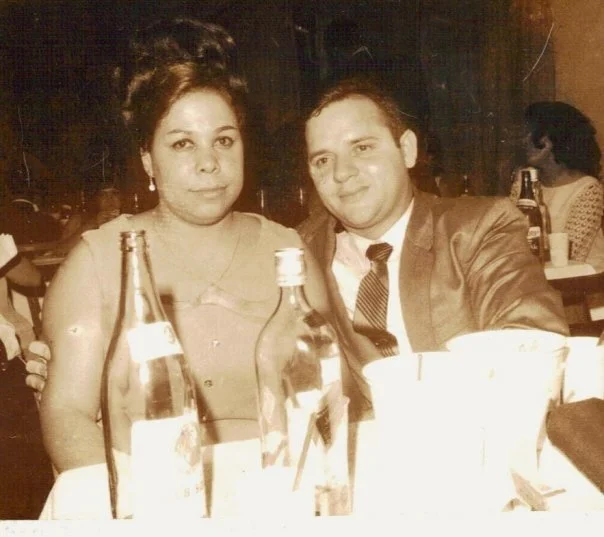
Tia Marina and Tio Pancho
Circa 1965
When Covid-19 took full steam and my lifestyle and safety was compromised, I took a deep breath, put my pride to the side and I moved back home to Harlem. After living on my own terms for 7 years, it’s been equal parts triggering and empowering to have my first ladies as my roommates.
Quaran life has given us ample time to share intergenerational stories and gain new perspectives from one another. It’s also placed me in a position to once again face those awkward conversations that arise when it comes to blackness. From my natural beauty choices to my preferred dating choices - my way is and has always been a point of wonder for my family.
Having to explain again and again what I find beautiful in black skin is exhausting. As a woman who identifies as black and who has spent the last 10 years piecing black history within my own family, I am exhausted. While clearing out old notebooks at home I found a personal reflection that I had written during my senior year in college. This reflection opened up old wounds. I had waited to share this today, on Dominican Mother’s Day. Little did I know that we’d have the racially charged week that we did. I have been in grief. Grief for the lack of allies in the Latino community. I have been enraged at the number of black latinos who still don’t get it. Who still succumb to the colonial programming passed on by our families. I found a reflection from way back that depicts my feelings as a young 20-year-old woman defining herself despite what her family has told her.
This reflection was written as a response to thoughts from my late aunt Tia Marina who happened to have the most black features from my grandmother’s siblings. Tia Marina emigrated to the South Bronx in the early ’60s and her whole vibe was about assimilating and lightning the race. My first public boyfriend was dark and Dominican. Tia Marina met him after my Sweet 16 and from then on and until her passing I’d have to listen to her comments about morenos, dating black and choosing the latter 🙄
One day she said these words that I’ll never forget:
Llevamos la raza negra detras de la oreja. (We carry the black race behind our ears)
I wrote this circa 2008. I was a sophomore in undergrad, traveling abroad, and expanding my understanding of what it means to be a Black Latina. This was equal parts a reflection and a conversation with myself and Tia who had died at the time.
Black behind the ears. That’s what Tia Marina said was the justification for girls like me who choose black men. I thought there is black in ALL of our Dominican men, not just behind the ears. “Shut your mouth girl, you would never want to be a cocola.” I see I said. So I sat back and I pulled a mirror and stared at my face. Doesn’t my big eyes, my full thick lips, my big nose, or my big butt make me like a cocola? Did I forget to mention my coarse hair? I mean Tia, I thought my features embody the recipe of a morena; a brown-skinned woman, no different than my African American sisters. Of a brown-skinned woman no different than Michelle Obama and Oprah.
Tia you forgot to teach your nieces and nephews that we’re not just black behind the ears. You forgot to teach your nieces and nephews about your Haitian father. You forgot to teach us to embrace our Haitian ancestry. But it’s ok. I was a victim of you and our family’s internal racism for years. But I no longer live or hide behind your thoughts. I see my ancestors in me. I am a daughter of the Diaspora, a child of the drums, a gift of Yoruba. I am the blend of indigenous Tainos, enslaved Africans, abused skin, and European Christian sinners.
You forgot the music you listened to has African roots, you forgot that the food that we eat is the same ate in Ghana. Next time you say you we’re black behind the ears, accept all that comes with it. The fight between Latinos and African Americans is real, like this recession that is real. Kids killing each other because of differences that are actually lines of difference that are closer to invisible. Girls hating their features and despising the warrior women of their past.
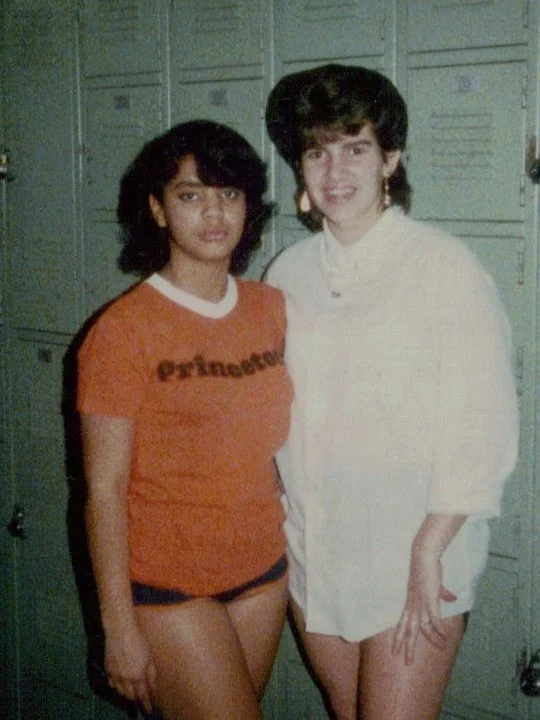
Elinor pictured on the left in the 80’s
Tia Marina died of leukemia and I never got to share this reflection with her. I recently spoke to her daughter (my cousin Elinor) and asked for permission to share this reflection. In conversation, I learned that Tia Marina also didn’t like it when she left her hair natural - my grandmother is the same way. Tia Marina would say parece una molleta, when Eli left her hair natural. Molleta is Dominican slang for a black woman.
Eli also shared that she’d say “ser blanco es una profession” (being white is a profession) - a.k.a. go make sure your hair looks clean and European. The fact that she saw being white as a profession speaks volumes to the kind of assimilation Tia Marina felt she needed to do as a woman of color in NYC in the 70’s. This assimilation that she would pass on to her daughter and which she tried for me to succumb to. While this is a narrative that has circulated for decades, I can’t and will never accept her views on “cocolos, molletas” or any other derogatory terms to describe black people.
She didn’t want me to look black at all - there was no way around that.
Let me grief some more while I come back to the pen.
-Ghislaine Leon