Remembering The Ladies
Being a woman in America still comes with a hefty price tag of inequality. From gender discrimination, our racial wage gap, to the male/female disparity in our political representation, women still have a lot to fight for. Women continue to be underrepresented in high level and high paying positions while overrepresented in low paying jobs. Women of color specifically experience higher levels of gender inequality and economic hardships. With Trump as our current and perhaps our most bizarre misogynist chief of America, we’ve seen a rise in women galvanizing into political action.
Recent movements like #LatinaEqualPayDay and #MeToo has further placed gender issues in the spotlight of policymakers and has defined a new time for female leadership. There’s no surprise to learn that 2020 will see a #BlackWomensEqualPayDay and a #NativeWomenEqualPayDay. In addition to 2020 being an election year, it is also the centennial of the ratification of the 19th Amendment which granted women (whites first of course) the right to vote.
In celebration of this milestone, The New-York Historical Society explores 200 years of women’s bold collective actions and efforts towards equality through Women March. The multi-media exhibition takes you on a journey that personifies the courage of American women and the evolution of democracy and citizenship in our nation. Through imagery, historical videos, and original media, Women March addresses issues like Indian removal, slavery, workplace safety, public health, civil rights, reproductive justice and freedom from violence, among other struggles in which our women have used their voice.
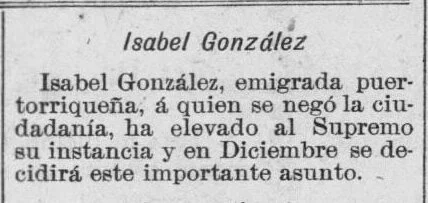
Snippet from La Democracia- March 18, 1903
While visiting the exhibit, I was so proud to learn and remember Isabel Gonzalez, a Puerto-Rican activist who paved the way for Puerto Ricans to be given U.S. Citizenship after she challenged our government. Her 1904 Supreme Court case (Gonzalez vs. Williams) was the 1st time our legislative system addressed the citizenship of the territories acquired by the United States. The then, twenty-year-old Isabel was carrying a baby and was returning to New York City to reunite with her fiancée who had found a job on the mainland. As the universe had it, while onboard on the S.S Philadelphia, the United States Department of Treasury issued new immigration protocols, ones that would label Isabel as an immigrant alien. At the time, Isabel believed herself to be a United States citizen, however, immigrant officials denied her from entering New York. The rest is our history.
The exhibit also reminded me of the solidarity and sisterhood African American women expressed despite their lack of representation or mention in the media during the suffrage years. Just two months after being established at Howard University, the Delta Sigma Theta sisters made their first political act by walking in the 1913 Suffragette Parade. This goes to show that women of color have intentionally come together for unity and freedom since before we had voting rights. It’s also a reminder that when brown women link-up we mean business. My most astounding finding was learning about the fearless Inez Garcia who killed a man who helped raped her thus becoming a female symbol for self-defense in the ’70s.
Experiencing Women March connected me with the slow and hard-fought gains earned during the generation of my great grandmothers. Learning about the number of rights and protection that the women before me didn’t have further ignited my fire to educate myself on our journey to where we are today. I feel so honored to be a woman after seeing all that we’ve accomplished together these last 100 years.
As women continue to move forward and expand in civic action, I hope that we can continue to push forward legislative action and draw world attention to the areas where we still face inequality. The future for our granddaughters lies in the continuous exploration of our intersectionality and the disparity still present in our society today.
This women’s history month, let’s remember the courageous ladies before us and the power that we’ve cultivated through collective action before our 21st Century. Women March is curated by Valerie Paley, Senior Vice President, Chief Historian, and Director of the Center for Women's History, and will be on display until August 30th, 2020.